












Cat. No:GM-88220AB
Product:Anti-CD98 hIgG1 Antibody(NPB15)





Cat. No:GM-88220AB
Product:Anti-CD98 hIgG1 Antibody(NPB15)
GM-88220AB-10 10 μg
GM-88220AB-100 100 μg
GM-88220AB-1000 1mg
Species Reactivity | Cynomolgus |
Clone | NPB15 |
Source/Isotype | Human IgG1(KDEL),kappa |
Application | Flow Cytometry |
Target | Detects CD98 |
Gene | CD98 |
Other Names | CD98LC, SLC7A5, 4F2LC, D16S469E, E16, LAT1, MPE16 CD98HC, SLC3A2, CD98, 4F2, 4F2HC, 4T2HC, CD98HC, MDU1 |
Gene ID | 101866986 (Cynomolgus) |
Background | CD98, also known as CD98HC CD98 protein or LAT1/CD98, is a type II membrane protein usually associated with the heavy chain of amino acid transporters such as LAT1. CD98 is widely expressed in many tissues, including liver, kidney, and various tumors. CD98 forms complexes with light chains of heterodimeric amino acid transporters such as LAT1 and LAT2. CD98 also interacts with integrins to affect cell adhesion and migration. CD98 is an important component of mTOR signaling pathway, which affects cell growth and proliferation. It also plays a role in integrin signaling pathways that regulate cell adhesion and migration. CD98 expression and function are associated with cancer and autoimmune diseases. High expression levels of CD98 are observed in various cancers, such as lymphomas, which are associated with increased tumor growth and poor prognosis. In autoimmune diseases such as Rheumatoid Arthritis, CD98 affects the activation and migration of immune cells. Proteins such as CP1 and FG1 interact with CD98 by affecting cellular and immune responses, leading to disease pathology. |
Storage | Store at 2-8℃ short term (1-2 weeks).Store at ≤ -20℃ long term. Avoid repeated freeze-thaw. |
Formulation | Phosphate-buffered solution, pH 7.2-7.4. |
Endotoxin | < 1 EU/mg, determined by LAL gel clotting assay |
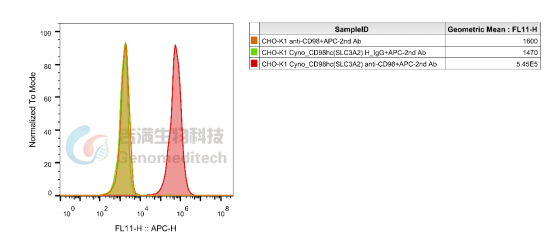
Flow cytometry | Cynomolgus_CD98hc(SLC3A2) CHO-K1 Cell Line (Catalog # GM-C29528) was stained with Anti-CD98 hIgG1 Antibody(NPB15) (Catalog # GM-88220AB) or isotype control antibody, followed by anti-Human IgG APC-conjugated Secondary Antibody. |




Cat. No:GM-88220AB
Product:Anti-CD98 hIgG1 Antibody(NPB15)
GM-88220AB-10 10 μg
GM-88220AB-100 100 μg
GM-88220AB-1000 1mg
Species Reactivity | Cynomolgus |
Clone | NPB15 |
Source/Isotype | Human IgG1(KDEL),kappa |
Application | Flow Cytometry |
Target | Detects CD98 |
Gene | CD98 |
Other Names | CD98LC, SLC7A5, 4F2LC, D16S469E, E16, LAT1, MPE16 CD98HC, SLC3A2, CD98, 4F2, 4F2HC, 4T2HC, CD98HC, MDU1 |
Gene ID | 101866986 (Cynomolgus) |
Background | CD98, also known as CD98HC CD98 protein or LAT1/CD98, is a type II membrane protein usually associated with the heavy chain of amino acid transporters such as LAT1. CD98 is widely expressed in many tissues, including liver, kidney, and various tumors. CD98 forms complexes with light chains of heterodimeric amino acid transporters such as LAT1 and LAT2. CD98 also interacts with integrins to affect cell adhesion and migration. CD98 is an important component of mTOR signaling pathway, which affects cell growth and proliferation. It also plays a role in integrin signaling pathways that regulate cell adhesion and migration. CD98 expression and function are associated with cancer and autoimmune diseases. High expression levels of CD98 are observed in various cancers, such as lymphomas, which are associated with increased tumor growth and poor prognosis. In autoimmune diseases such as Rheumatoid Arthritis, CD98 affects the activation and migration of immune cells. Proteins such as CP1 and FG1 interact with CD98 by affecting cellular and immune responses, leading to disease pathology. |
Storage | Store at 2-8℃ short term (1-2 weeks).Store at ≤ -20℃ long term. Avoid repeated freeze-thaw. |
Formulation | Phosphate-buffered solution, pH 7.2-7.4. |
Endotoxin | < 1 EU/mg, determined by LAL gel clotting assay |
Flow cytometry | Cynomolgus_CD98hc(SLC3A2) CHO-K1 Cell Line (Catalog # GM-C29528) was stained with Anti-CD98 hIgG1 Antibody(NPB15) (Catalog # GM-88220AB) or isotype control antibody, followed by anti-Human IgG APC-conjugated Secondary Antibody. |