




400+ Engineered Cell Lines 2,000+ Stable Cell Lines 300+ Reporter Cell Lines
60+ Host Cells 1000+ Assay Projects
400+ Engineered Cell Lines 2,000+ Stable Cell Lines 300+ Reporter Cell Lines
60+ Host Cells 1000+ Assay Projects
A comprehensive collection of engineered cell models covering diverse therapeutic targets, signaling pathways, and immune functions, providing a robust foundation for cell-based assay development.
Reproducible Results
Engineered clonal stable cell lines minimize donor variability and batch-to-batch variation for consistent results.
Highly Sensitive Quantification
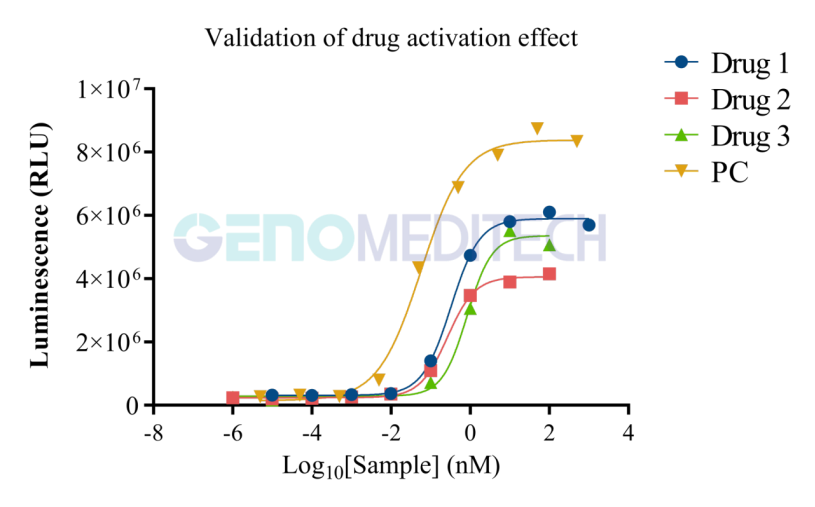
Luciferase reporters provide signal amplification and a broad dynamic range for sensitive potency assessment.
Wide Assay Window & Comparable Readouts
Low background and million-level RLU signals enable robust signal separation and cross-batch data comparison.
Compliance & Traceability
Commercial use authorization for key cell lines, including HEK293, Jurkat E6.1, and CHO-K1, with traceability documentation available.
Quantitative ADCC Effector Function Assessment
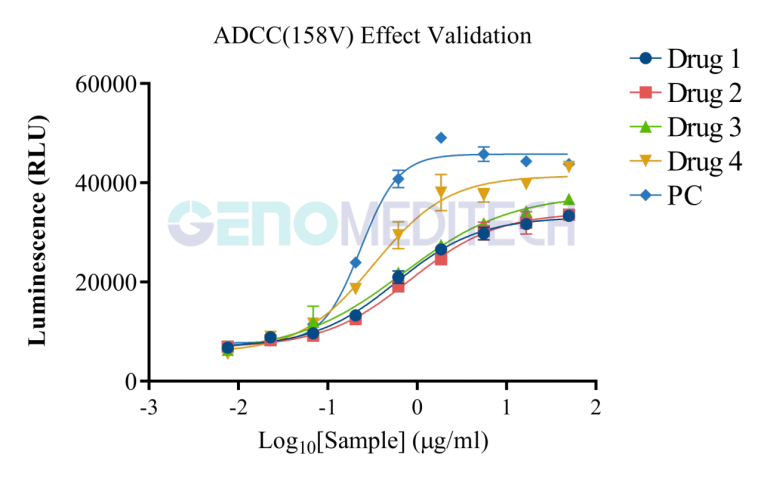
GM-C05619 FcγRIIIa (158V) Reporter Jurkat

Stable expression of FcγRIIIa and NFAT-Luc enables quantitative assessment of antibody-dependent cellular cytotoxicity (ADCC).
Wide Assay Window | EC50 Quantification | Comparative Potency Assessment
Supports functional assessment of ADCC, ADCP, CDC, and internalization for ADC and Fc-engineered antibody candidates.
CTLA-4 / PD-1 Dual-Pathway Blockade Activity
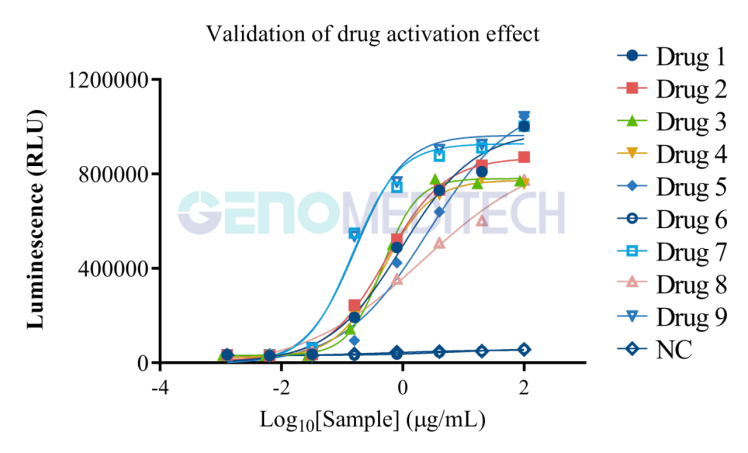
GM-C26486 H_CTLA4 PD-1 Reporter + GM-C30574 H_CD80 PDL1 aAPC CHO-K1

Paired reporter and aAPC cells enable quantitative assessment of immune checkpoint blockade activity in monoclonal antibodies, bispecific antibodies, and combination treatments.
Low Background | Wide Assay Window | EC50 Quantification
Supports multi-pathway immune checkpoint evaluation and functional characterization of T-cell engager (TCE) molecules.
Functional Evaluation of PD-1–IL-2v Fusion Proteins
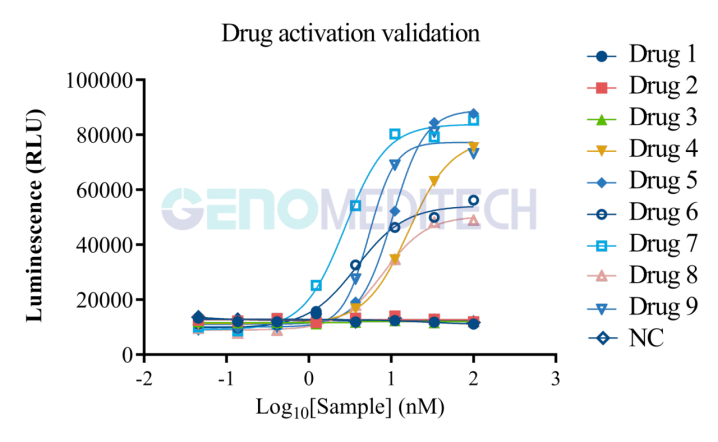
GM-C41979 H_CD25 CD122 CD132 PD1 Reporter Jurkat

Co-expression of PD-1 and the complete IL-2 receptor complex enables evaluation of PD-1-dependent immune activation.
Low Background | Target-Specific Validation | EC50 Quantification
A PD-1-negative parental control enables differentiation between target-dependent and nonspecific activation.
DR3 / TL1A Pathway Antagonist Activity Assessment
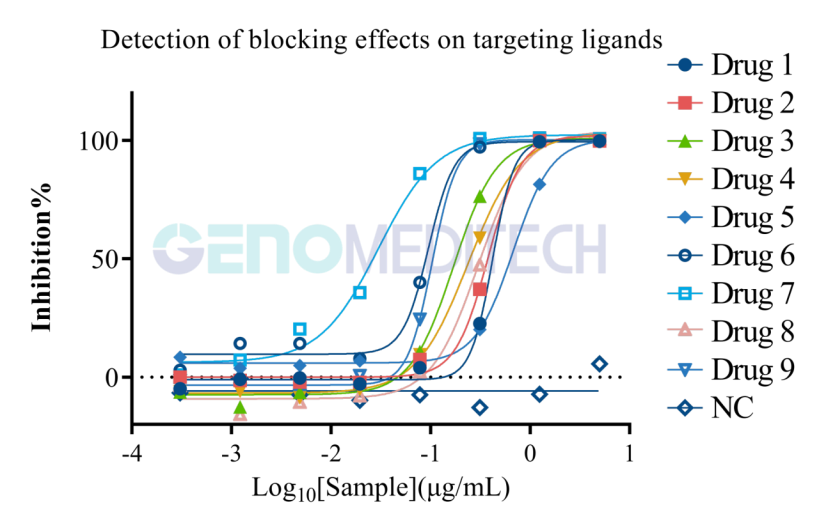
GM-C30290 H_TNFRSF25 (DR3) Reporter Jurkat

Stable expression of DR3 and a luciferase reporter enables both agonist activity screening and antagonist blockade assessment in a single cell model.
Wide Assay Window | IC50 Quantification | High Inter-Batch Reproducibility
Supports functional characterization of agonists and antagonists targeting OX40/OX40L, TSLP, TL1A/DR3, and other immune signaling pathways.
Multi-Target GPCR Agonist Activity Assessment
GM-C25536 H_GIPR Reporter CHO-K1

Stable expression of GIPR and CRE-Luc enables quantitative assessment of GPCR-mediated receptor activation.
Wide Assay Window | EC50 Quantification | Comparative Receptor Activation
Enables potency and selectivity profiling of single, dual, and triple agonists targeting GLP-1R, GIPR, and GCGR.
400+ Engineered Cell Lines 2,000+ Stable Cell Lines 300+ Reporter Cell Lines
60+ Host Cells 1000+ Assay Projects
A comprehensive collection of engineered cell models covering diverse therapeutic targets, signaling pathways, and immune functions, providing a robust foundation for cell-based assay development.
Reproducible Results
Engineered clonal stable cell lines minimize donor variability and batch-to-batch variation for consistent results.
Highly Sensitive Quantification
Luciferase reporters provide signal amplification and a broad dynamic range for sensitive potency assessment.
Wide Assay Window & Comparable Readouts
Low background and million-level RLU signals enable robust signal separation and cross-batch data comparison.
Compliance & Traceability
Commercial use authorization for key cell lines, including HEK293, Jurkat E6.1, and CHO-K1, with traceability documentation available.
Quantitative ADCC Effector Function Assessment
GM-C05619 FcγRIIIa (158V) Reporter Jurkat

Stable expression of FcγRIIIa and NFAT-Luc enables quantitative assessment of antibody-dependent cellular cytotoxicity (ADCC).
Wide Assay Window | EC50 Quantification | Comparative Potency Assessment
Supports functional assessment of ADCC, ADCP, CDC, and internalization for ADC and Fc-engineered antibody candidates.
CTLA-4 / PD-1 Dual-Pathway Blockade Activity
GM-C26486 H_CTLA4 PD-1 Reporter + GM-C30574 H_CD80 PDL1 aAPC CHO-K1

Paired reporter and aAPC cells enable quantitative assessment of immune checkpoint blockade activity in monoclonal antibodies, bispecific antibodies, and combination treatments.
Low Background | Wide Assay Window | EC50 Quantification
Supports multi-pathway immune checkpoint evaluation and functional characterization of T-cell engager (TCE) molecules.
Functional Evaluation of PD-1–IL-2v Fusion Proteins
GM-C41979 H_CD25 CD122 CD132 PD1 Reporter Jurkat

Co-expression of PD-1 and the complete IL-2 receptor complex enables evaluation of PD-1-dependent immune activation.
Low Background | Target-Specific Validation | EC50 Quantification
A PD-1-negative parental control enables differentiation between target-dependent and nonspecific activation.
DR3 / TL1A Pathway Antagonist Activity Assessment
GM-C30290 H_TNFRSF25 (DR3) Reporter Jurkat

Stable expression of DR3 and a luciferase reporter enables both agonist activity screening and antagonist blockade assessment in a single cell model.
Wide Assay Window | IC50 Quantification | High Inter-Batch Reproducibility
Supports functional characterization of agonists and antagonists targeting OX40/OX40L, TSLP, TL1A/DR3, and other immune signaling pathways.
Multi-Target GPCR Agonist Activity Assessment
GM-C25536 H_GIPR Reporter CHO-K1

Stable expression of GIPR and CRE-Luc enables quantitative assessment of GPCR-mediated receptor activation.
Wide Assay Window | EC50 Quantification | Comparative Receptor Activation
Enables potency and selectivity profiling of single, dual, and triple agonists targeting GLP-1R, GIPR, and GCGR.