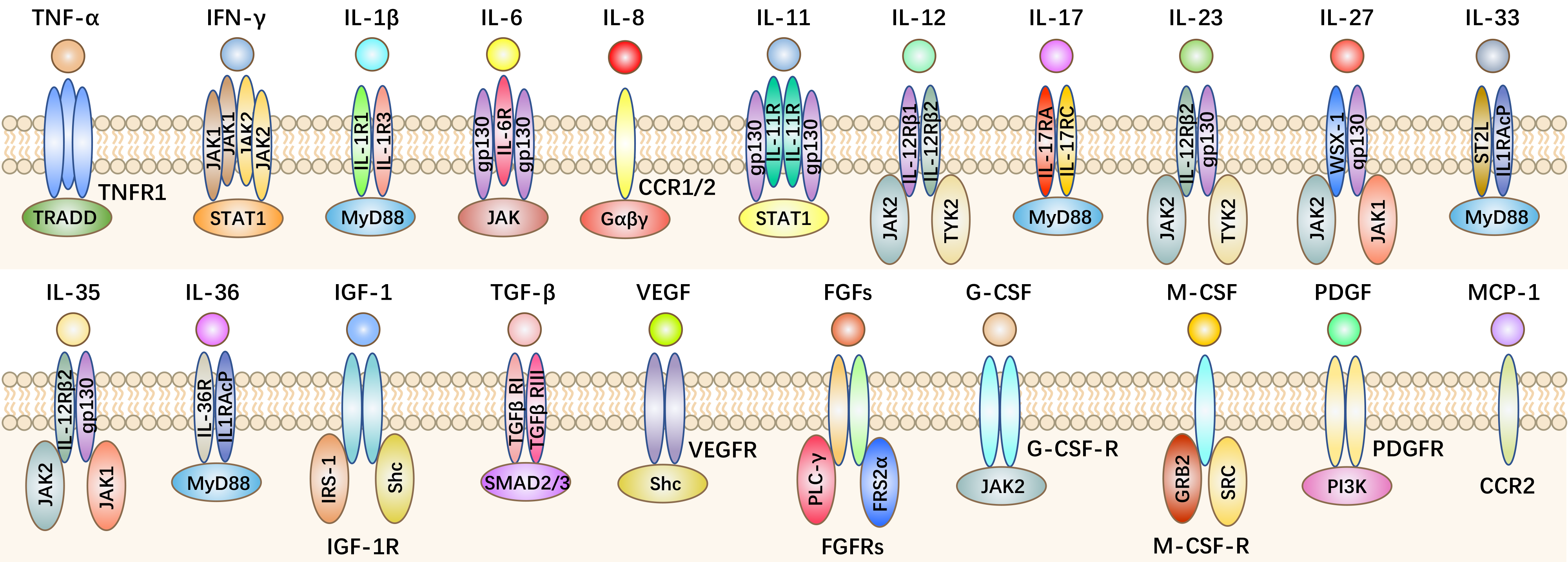
Cytokines are a diverse group of low-molecular-weight, soluble proteins secreted by various cell types in response to immune stimuli. As key regulators of cell signaling, they play essential roles in innate and adaptive immunity, hematopoiesis, cell proliferation, and tissue repair.
Cytokines function through autocrine, paracrine, and endocrine pathways, forming a highly dynamic and interconnected regulatory network. However, dysregulation of cytokine signaling can contribute to disease progression, including severe inflammatory responses such as cytokine storms. To support reliable and efficient cytokine research, we provide both cytokine expression cell lines and reporter cell lines, enabling robust and reproducible in vitro studies.
Empowering Cytokine Research with Reliable Tools
Given the complexity of cytokine signaling and its critical role in disease, reliable in vitro models are essential for accurate evaluation and discovery.
We provide:
|
Cytokine Expression Cell Lines
Enable stable and efficient production of cytokines Support functional studies and assay development Facilitate high-throughput screening and protein characterization Provide consistent and reproducible results across experiments Compatible with various downstream applications
|
Cytokine Reporter Cell Lines
Provide sensitive and quantitative readouts Monitor cytokine pathway activation and signaling dynamics Allow real-time tracking of cellular responses Ideal for pathway validation and mechanistic studies Support multi-target or combinatorial screening assays
|
Together, these cell-based platforms support diverse disease research areas, including immunology, inflammatory and autoimmune diseases, oncology, infectious diseases, and metabolic diseases, enabling more consistent and reliable cytokine-focused studies.





| Product No. | Product Name | Gene | Pre-order/order |
|
Signaling Pathway |
Stability |
|
|
|
|
The H_PD1 SHP1 Reporter Jurkat Cell line (GM-C42135) response to Recombinant Human IL-6. |
The passaging stability of H_OX40 Reporter DDX35™ Cell Line (GM-C36735) response to Human OX40L Protein |
|
|
|
|
Applications |
Expression |
|
|
|
|
The H_OX40 Reporter DDX35™ Cell Line response to Anti-OX40L hIgG4 Antibody. |
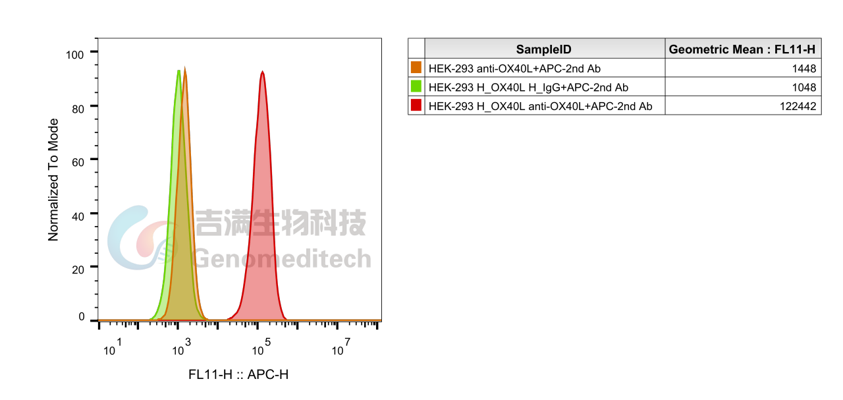
H_OX40L HEK-293 Cell Line (GM-C35017) was determined by flow cytometry using Anti-OX40L hIgG4 Antibody.
|

Cytokines are a diverse group of low-molecular-weight, soluble proteins secreted by various cell types in response to immune stimuli. As key regulators of cell signaling, they play essential roles in innate and adaptive immunity, hematopoiesis, cell proliferation, and tissue repair.
Cytokines function through autocrine, paracrine, and endocrine pathways, forming a highly dynamic and interconnected regulatory network. However, dysregulation of cytokine signaling can contribute to disease progression, including severe inflammatory responses such as cytokine storms. To support reliable and efficient cytokine research, we provide both cytokine expression cell lines and reporter cell lines, enabling robust and reproducible in vitro studies.
Empowering Cytokine Research with Reliable Tools
Given the complexity of cytokine signaling and its critical role in disease, reliable in vitro models are essential for accurate evaluation and discovery.
We provide:
|
Cytokine Expression Cell Lines
Enable stable and efficient production of cytokines Support functional studies and assay development Facilitate high-throughput screening and protein characterization Provide consistent and reproducible results across experiments Compatible with various downstream applications
|
Cytokine Reporter Cell Lines
Provide sensitive and quantitative readouts Monitor cytokine pathway activation and signaling dynamics Allow real-time tracking of cellular responses Ideal for pathway validation and mechanistic studies Support multi-target or combinatorial screening assays
|
Together, these cell-based platforms support diverse disease research areas, including immunology, inflammatory and autoimmune diseases, oncology, infectious diseases, and metabolic diseases, enabling more consistent and reliable cytokine-focused studies.
| Product No. | Product Name | Gene | Pre-order/order |
|
Signaling Pathway |
Stability |
|
|
|
|
The H_PD1 SHP1 Reporter Jurkat Cell line (GM-C42135) response to Recombinant Human IL-6. |
The passaging stability of H_OX40 Reporter DDX35™ Cell Line (GM-C36735) response to Human OX40L Protein |
|
|
|
|
Applications |
Expression |
|
|
|
|
The H_OX40 Reporter DDX35™ Cell Line response to Anti-OX40L hIgG4 Antibody. |
H_OX40L HEK-293 Cell Line (GM-C35017) was determined by flow cytometry using Anti-OX40L hIgG4 Antibody.
|