









Precise regulation of the immune system has long been a major focus in biopharmaceutical research and development. In recent years, beyond classical immune checkpoints such as PD-1/PD-L1, emerging immune regulatory targets centered on T-cell co-stimulatory pathways have attracted increasing attention. Among them, the OX40/OX40L signaling axis has become a key research focus in immunotherapy due to its critical role in regulating T-cell activation, expansion, and long-term immune memory.
As a typical T-cell co-stimulatory receptor, OX40 activates downstream signaling pathways through binding with its ligand OX40L, promoting enhanced effector T-cell function and survival. In disease treatment, the OX40/OX40L axis demonstrates the potential for bidirectional immune regulation: on one hand, blocking OX40 signaling may help suppress excessive immune responses and provide new therapeutic strategies for autoimmune diseases; on the other hand, activating the OX40 pathway can enhance anti-tumor immunity, offering new opportunities for cancer immunotherapy.
With multiple OX40/OX40L-targeted therapies advancing into clinical development, this target continues to demonstrate therapeutic potential through innovative treatment strategies and combination approaches, maintaining strong interest and ongoing exploration within the immunotherapy field.
OX40 & OX40L
The transmembrane glycoprotein OX40 (also known as CD134, ACT35, and TNFRSF4) and its ligand OX40L are key regulators of human adaptive immune responses. OX40 was first identified in 1987 on activated mouse CD4⁺ T cells and is a member of the tumor necrosis factor receptor (TNFR) superfamily.
OX40 is a type I transmembrane glycoprotein consisting of 249 amino acids, with 49 amino acids located in the cytoplasmic domain and 186 amino acids in the extracellular region. Its ligand, OX40L, is a type II glycoprotein containing a 133-amino-acid extracellular domain and a 23-amino-acid cytoplasmic tail, and is typically expressed as a trimeric molecule.
OX40 is primarily expressed on activated CD4⁺ T cells and CD8⁺ T cells, while its expression levels on NK cells and NKT cells are relatively low. T-cell receptor (TCR) signaling can initiate OX40 expression on various cell types, while CD28 signaling and other cytokines can further enhance its expression on activated T cells. It has also been reported that IL-2, IL-4, and TNF can increase or prolong OX40 expression.
In animal models of non-alcoholic steatohepatitis (NASH), IL-2, TNF-α, and IFN-γ are highly expressed in liver tissues; however, only exogenous IL-2 stimulation was shown to upregulate OX40 expression on CD4⁺ T cells.
OX40L is mainly expressed on antigen-presenting cells (APCs), including B cells and dendritic cells (DCs). OX40L expression can be detected on APCs within 1–3 days after antigen exposure. CD40 signaling and inflammatory signals transmitted through Toll-like receptors (TLRs) can induce OX40L expression on APCs. In addition, cytokines and mediators such as IL-18, IFN-γ, thymic stromal lymphopoietin (TSLP), and prostaglandin E2 (PGE2) can also promote OX40L expression.
Beyond professional APCs such as activated B cells, dendritic cells, and macrophages, OX40L is also expressed on other cell types, including NK cells, mast cells, smooth muscle cells, and vascular endothelial cells.
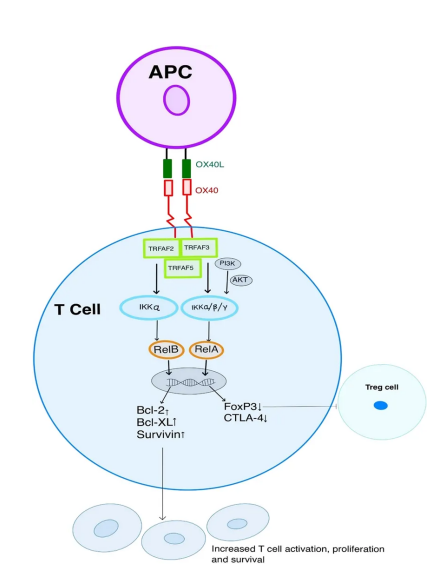
OX40/OX40 Linteraction with downstream signaling results in T cell activation, proliferation, and increased survival.
Signaling Pathway
The biological function of the OX40/OX40L signaling pathway is to enhance T-cell activation signals initiated by the T-cell receptor (TCR), thereby significantly amplifying the strength and duration of T-cell immune responses.
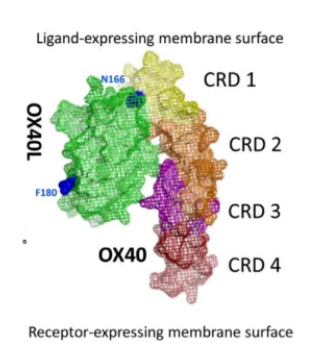
OX40–OX40L Interaction Model
As an important T-cell co-stimulatory receptor, OX40 binding to OX40L activates a series of downstream signaling pathways, including PI3K-PKB/AKT, nuclear factor of activated T cells (NFAT), and NF-κB pathways. Among these, the major functional signaling pathways include:
NF-κB1 pathway: Promotes Akt phosphorylation and supports sustained T-cell proliferation and survival.
PI3K/Akt pathway: Upregulates the expression of anti-apoptotic molecules such as Bcl-xL and Bcl-2, thereby extending the survival of effector T cells.
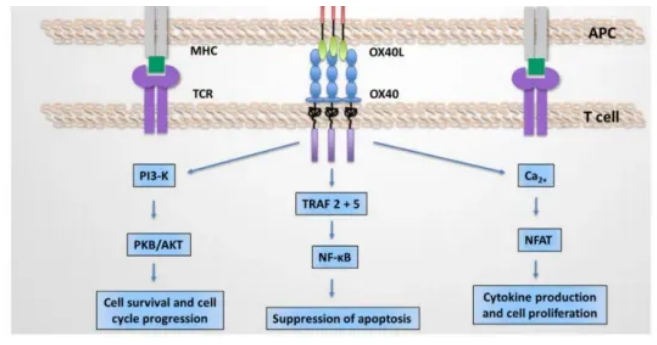
Downstream signaling pathways of OX40
The OX40/OX40L signaling axis integrates multiple co-stimulatory signals to continuously enhance T-cell proliferation, survival, and effector functions, playing a central role in regulating adaptive immune responses.
Competitive Landscape
Dual Potential in Immunotherapy
With its critical role in regulating T-cell activation, immune memory formation, and immune microenvironment modulation, the OX40/OX40L signaling axis has emerged as an important immunotherapy target beyond classical immune checkpoints such as PD-1/PD-L1. Unlike many immune targets with a single regulatory function, OX40/OX40L exhibits unique bidirectional immunomodulatory potential: on one hand, inhibiting excessive T-cell activation may provide therapeutic benefits for autoimmune and inflammatory diseases; on the other hand, enhancing T-cell effector function may strengthen anti-tumor immunity. As a result, OX40/OX40L-targeted therapies have developed along two major therapeutic directions: autoimmune/inflammatory diseases and cancer immunotherapy.
Autoimmune and Inflammatory Diseases
In autoimmune and inflammatory diseases, the OX40/OX40L pathway is primarily viewed as a key regulator of abnormal T-cell activation. By blocking the interaction between OX40 and OX40L, therapeutic approaches aim to reduce persistent immune activation and restore immune homeostasis, thereby alleviating chronic inflammatory responses driven by pathogenic T cells.
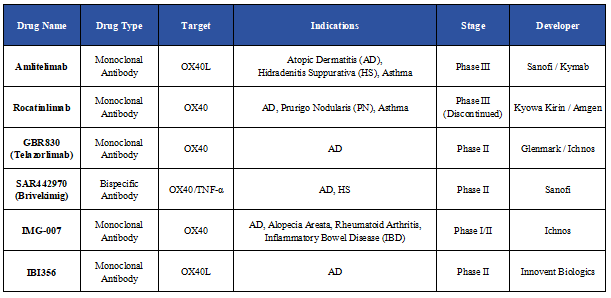
Currently, this field represents one of the more advanced areas of OX40/OX40L development, with a strong focus on immune-mediated disorders such as atopic dermatitis. Representative candidates, including Rocatinlimab, an anti-OX40 monoclonal antibody, and Amlitelimab, an anti-OX40L monoclonal antibody, have progressed into late-stage clinical development. In addition, programs such as GBR830 (Telazorlimab) and IBI356 are further exploring the therapeutic potential of OX40/OX40L blockade in autoimmune diseases.
However, compared with established immune targets such as TNF, IL-4Rα, and IL-13, the clinical differentiation of OX40/OX40L-targeted therapies remains to be further validated, particularly regarding long-term efficacy, patient selection strategies, and commercial potential.
Cancer Immunotherapy
In cancer immunotherapy, OX40 represents a distinct therapeutic strategy by activating co-stimulatory signaling to enhance T-cell function. Unlike PD-1/PD-L1 checkpoint inhibitors, which primarily restore exhausted T-cell activity by releasing immune suppression, OX40 agonists aim to further promote T-cell expansion, survival, and memory formation, providing a complementary approach to strengthen anti-tumor immune responses.
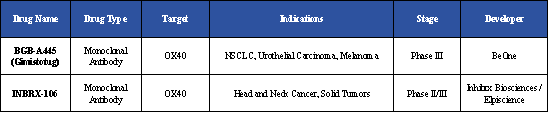
With the continued evolution of combination immunotherapy strategies, OX40 agonists have emerged as an important area of exploration for next-generation immune activation therapies. A representative program, INBRX-106, is a hexavalent OX40 agonist designed to enhance receptor clustering and downstream signaling activation, and is currently being evaluated in head and neck squamous cell carcinoma (HNSCC) and other solid tumors.
Importantly, early clinical findings suggest that OX40 activation may help overcome limitations associated with existing checkpoint therapies. In combination with PD-1 inhibitors, INBRX-106 achieved an objective response rate (ORR) of 41.7% in PD-1-refractory, PD-L1-high non-small cell lung cancer (NSCLC) patients, suggesting potential value for OX40 agonism in reactivating anti-tumor immunity in patients with limited response to prior checkpoint blockade.
Other OX40 agonists, including BGB-A445, are also advancing through clinical development, further expanding the therapeutic landscape of OX40-targeted immunotherapy.
Summary
The OX40/OX40L axis is being actively explored across both autoimmune diseases and oncology. While clinical development in autoimmune indications has progressed more rapidly, oncology applications have faced greater challenges, including limited efficacy as a monotherapy and safety concerns such as cytokine release syndrome (CRS). As a result, current research efforts are increasingly focusing on combination strategies, particularly with PD-1/PD-L1 checkpoint inhibitors, to enhance anti-tumor immune responses.
As clinical validation continues and therapeutic strategies evolve, the potential value of the OX40/OX40L pathway is expected to become further defined, opening new opportunities for immune modulation in both autoimmune and cancer treatment.
Genomeditech has been deeply engaged in the development of OX40-targeted therapeutics, offering a comprehensive one-stop solution covering target proteins, stable overexpression cell lines, reporter gene assay cell lines, and antibody products. We are committed to providing research and industry partners with highly stable and consistent R&D tools to accelerate OX40-related drug discovery and translational development.
Learn more: https://en.genomeditech.com/v2/search?k=OX40
Reference
ClinicalTrials.gov. (2026, October 23). Safety and Preliminary Effectiveness of BGB-A445 in Combination With Tislelizumab in Participants With Advanced Solid Tumors. https://clinicaltrials.gov/study/NCT04215978
Inhibrx Biosciences. (n.d.). INBRX-106: A next-generation OX40 agonist antibody. https://inhibrx.com/inbrx-106/
Sanofi. (2026, March 28). Sanofi’s amlitelimab confirms its potential in atopic dermatitis: New results from Phase 3 studies presented at AAD. https://www.sanofi.com/en/media-room/press-releases/2026/2026-03-28-15-00-00-3264184
Kyowa Kirin Co., Ltd. (2026, March 3). Amgen and Kyowa Kirin announce updates on rocatinlimab clinical development program. https://www.kyowakirin.com/media_center/news_releases/2026/e20260303_01.html
Glenmark Pharmaceuticals. (2021). Glenmark Pharmaceuticals announces initiation of a Phase 2b trial of GBR 830, a first-in-class investigational anti-OX40 monoclonal antibody for the treatment of moderate-to-severe atopic dermatitis. https://glenmarkpharma-us.com/press/glenmark-pharmaceuticals-announces-initiation-of-a-phase-2b-trial-of-gbr-830-a-first-in-class-investigational-anti-ox40-monoclonal-antibody-for-the-treatment-of-moderate-to-severe-atopic-dermatitis/
Sanofi. (n.d.). Clinical trial: NCT06975722. Sanofi Clinical Trials. https://www.sanofi.com/en/clinical-trials/nct06975722
Ichnos Glenmark Innovation. (2025). Inmagene doses first patient in adaptive Phase 2b trial of IMG-007 in atopic dermatitis. https://ir.imagenebio.com/news-releases/news-release-details/inmagene-doses-first-patient-adaptive-phase-2b-trial-img-007
ClinicalTrials.gov. (2026, March 3). A Study to Evaluate Efficacy and Safety of IBI356 in Participants With Moderate to Severe Atopic Dermatitis. U.S. National Library of Medicine. https://clinicaltrials.gov/study/NCT07330934