








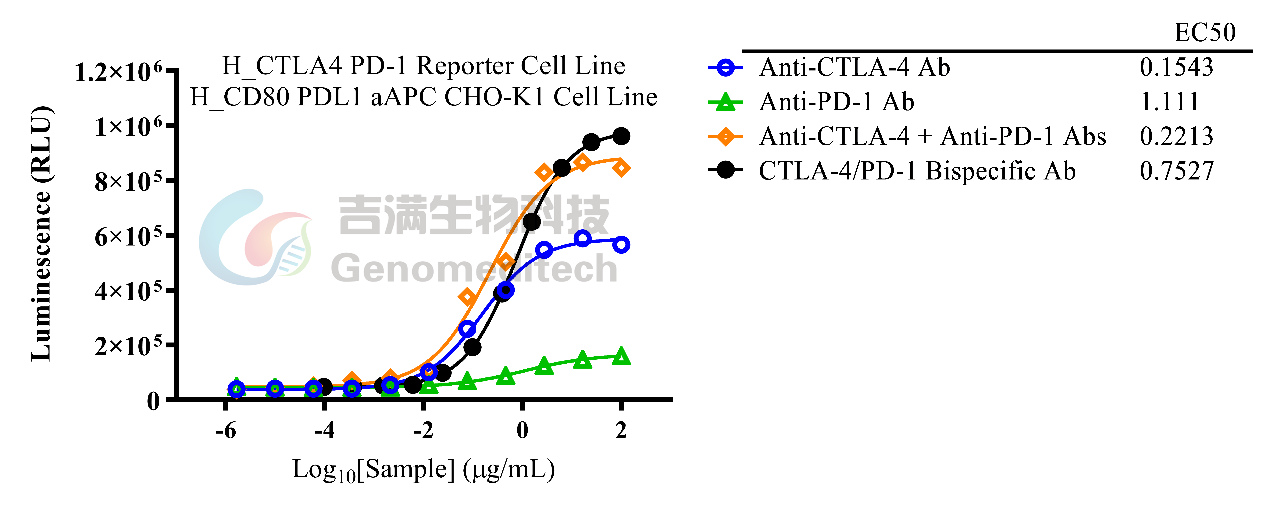




| Species Reactivity | Human |
| Specificity | Detects human CTLA-4 and PD-1. |
| Source/Isotype | Monoclonal human IgG1, κ |
| Application | Binding activation: 100 pg/mL-100 μg/mL |
| Background | PD-1 is an immunosuppressive receptor expressed by activated T and B cells and plays a key role in the regulation of the immune response to tumor antibodies and autoantigens. The interaction between PD-1 and its ligand PD-L1 or PD-L2 in neighboring cells can inhibit the conduction of TCR signaling pathway and the effects of TCR-mediated cell proliferation, transcriptional activation, and cytokine production. Therapeutic antibodies and Fc fusion proteins used to block PD-1/PD-L1 interactions have been shown to be promising in clinical trials for the treatment of various cancers. CTLA-4, also known as CD152, is an immunosuppressive receptor that is constitutively expressed on regulatory T cells (TreGs). It plays a key role in the regulation of immune response. When CTLA4 is upregulated on T cell surface, T cells bind to CD80(B7-1) or CD86(B7-2) with a higher affinity than CD28's positive costimulatory signal, thus inducing T cell nonreactivity. Antibodies and Fc fusion proteins that block the interaction of CTLA4/CD80 and CD86 have been shown to have promising applications in clinical trials against various cancers. |
| Storage | Store at +4℃ short term (1-2 weeks). Store at -20℃ long term |
| Formulation | Phosphate-buffered solution, pH 7.2. |
| Species Reactivity | Human |
| Specificity | Detects human CTLA-4 and PD-1. |
| Source/Isotype | Monoclonal human IgG1, κ |
| Application | Binding activation: 100 pg/mL-100 μg/mL |
| Background | PD-1 is an immunosuppressive receptor expressed by activated T and B cells and plays a key role in the regulation of the immune response to tumor antibodies and autoantigens. The interaction between PD-1 and its ligand PD-L1 or PD-L2 in neighboring cells can inhibit the conduction of TCR signaling pathway and the effects of TCR-mediated cell proliferation, transcriptional activation, and cytokine production. Therapeutic antibodies and Fc fusion proteins used to block PD-1/PD-L1 interactions have been shown to be promising in clinical trials for the treatment of various cancers. CTLA-4, also known as CD152, is an immunosuppressive receptor that is constitutively expressed on regulatory T cells (TreGs). It plays a key role in the regulation of immune response. When CTLA4 is upregulated on T cell surface, T cells bind to CD80(B7-1) or CD86(B7-2) with a higher affinity than CD28's positive costimulatory signal, thus inducing T cell nonreactivity. Antibodies and Fc fusion proteins that block the interaction of CTLA4/CD80 and CD86 have been shown to have promising applications in clinical trials against various cancers. |
| Storage | Store at +4℃ short term (1-2 weeks). Store at -20℃ long term |
| Formulation | Phosphate-buffered solution, pH 7.2. |