






Where Discovery Begins
Anti-SSTR2 hIgG1 Antibody(XENP018087)
Research Grade
Cat. No.
GM-59883AB
Size
10 μg
100 μg
1mg
Quote
Data display
Description
Related products
Data display
Flow cytometry
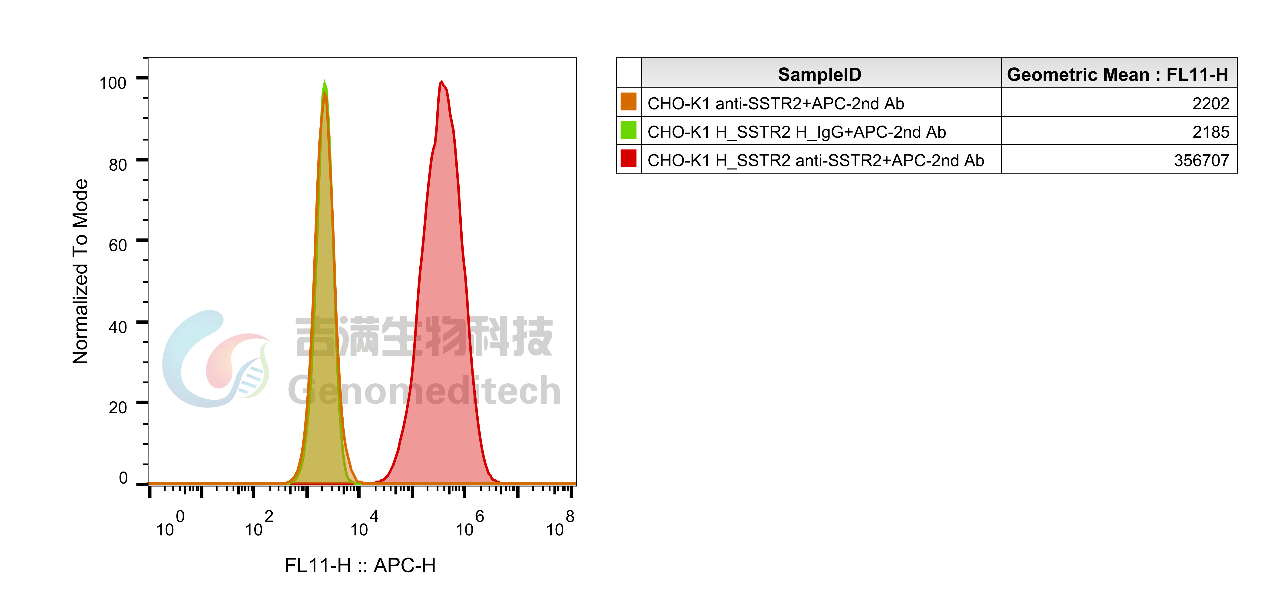
H_SSTR2 CHO-K1 Cell Line (Catalog # GM-C28873) was stained with Anti-SSTR2 hIgG1 Antibody (Catalog # GM-59883AB) or isotype control antibody, followed by anti-Human IgG APC-conjugated Secondary Antibody.
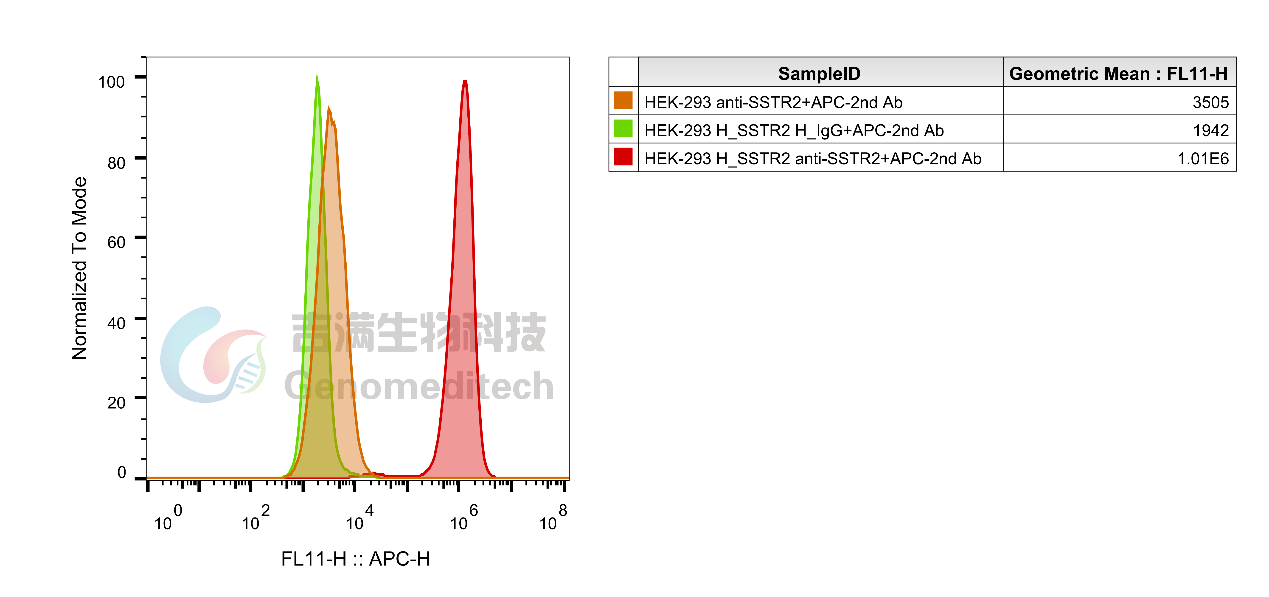
H_SSTR2 HEK-293 Cell Line (Catalog # GM-C28874) was stained with Anti-SSTR2 hIgG1 Antibody (Catalog # GM-59883AB) or isotype control antibody, followed by anti-Human IgG APC-conjugated Secondary Antibody.
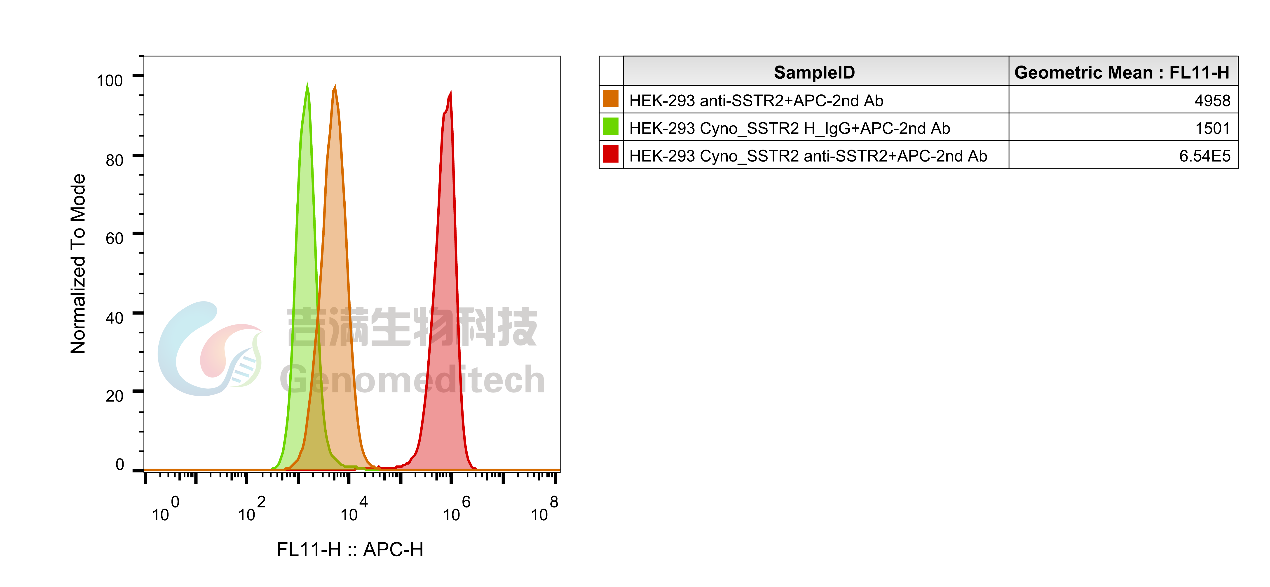
Cynomolgus_SSTR2 HEK-293 Cell Line (Catalog # GM-C28875) was stained with Anti-SSTR2 hIgG1 Antibody (Catalog # GM-59883AB) or isotype control antibody, followed by anti-Human IgG APC-conjugated Secondary Antibody.
Description
Species Reactivity Human
Specificity Detects human SSTR2. It also detects cynomolgus SSTR2.
Source/Isotype Monoclonal human IgG1, κ
Other Names SST2
Gene ID 6752(human), cynomolgus(102142925)
Application Flow cytometry: 0.5 μg-2 μg /test; FC-Quality tested
Background Somatostatin receptor type 2 is a protein that in humans is encoded by the SSTR2 gene. The somatostatin receptor 2 (SSTR2), which belongs to the G-protein coupled receptor family, is a protein which is most highly expressed in the pancreas (both alpha- and beta-cells), but also in other tissues such as the cerebrum and kidney and in lower amount in the jejunum, colon and liver. In the pancreas, after binding to somatostatin, it inhibits the secretion of peptide hormones from pancreatic islets. During development, it stimulates neuronal migration and axon outgrowth. The somatostatin receptor 2 is expressed in most tumors. Patients with neuroendocrine tumors that over-express the somatostatin receptor 2 have an improved prognosis. The over expression of SSTR2 in tumors can be exploited to selectively deliver radio-peptides to tumors to either detect or destroy them. Somatostatin receptor 2 also has the ability to stimulate apoptosis in many cells including cancer cells. The somatostatin receptor 2 is also being looked at as a possible target in cancer treatment for its ability to inhibit tumor growth.
Storage Store at +4℃ short term (1-2 weeks). Store at -20℃ long term
Formulation Phosphate-buffered solution, pH 7.2.
Species Reactivity Human
Specificity Detects human SSTR2. It also detects cynomolgus SSTR2.
Source/Isotype Monoclonal human IgG1, κ
Other Names SST2
Gene ID 6752(human), cynomolgus(102142925)
Application Flow cytometry: 0.5 μg-2 μg /test; FC-Quality tested
Background Somatostatin receptor type 2 is a protein that in humans is encoded by the SSTR2 gene. The somatostatin receptor 2 (SSTR2), which belongs to the G-protein coupled receptor family, is a protein which is most highly expressed in the pancreas (both alpha- and beta-cells), but also in other tissues such as the cerebrum and kidney and in lower amount in the jejunum, colon and liver. In the pancreas, after binding to somatostatin, it inhibits the secretion of peptide hormones from pancreatic islets. During development, it stimulates neuronal migration and axon outgrowth. The somatostatin receptor 2 is expressed in most tumors. Patients with neuroendocrine tumors that over-express the somatostatin receptor 2 have an improved prognosis. The over expression of SSTR2 in tumors can be exploited to selectively deliver radio-peptides to tumors to either detect or destroy them. Somatostatin receptor 2 also has the ability to stimulate apoptosis in many cells including cancer cells. The somatostatin receptor 2 is also being looked at as a possible target in cancer treatment for its ability to inhibit tumor growth.
Storage Store at +4℃ short term (1-2 weeks). Store at -20℃ long term
Formulation Phosphate-buffered solution, pH 7.2.
Related products
For laboratory research use only. Direct human use, including taking orally and injection and clinical use are forbidden.
Anti-SSTR2 hIgG1 Antibody(XENP018087)
Research Grade
Anti-SSTR2 hIgG1 Antibody(XENP018087)
Research Grade
Cat. No.
GM-59883AB
Size
10 μg
100 μg
1mg
Quote
Data display
Description
Related products
Data display
Flow cytometry
H_SSTR2 CHO-K1 Cell Line (Catalog # GM-C28873) was stained with Anti-SSTR2 hIgG1 Antibody (Catalog # GM-59883AB) or isotype control antibody, followed by anti-Human IgG APC-conjugated Secondary Antibody.
H_SSTR2 HEK-293 Cell Line (Catalog # GM-C28874) was stained with Anti-SSTR2 hIgG1 Antibody (Catalog # GM-59883AB) or isotype control antibody, followed by anti-Human IgG APC-conjugated Secondary Antibody.
Cynomolgus_SSTR2 HEK-293 Cell Line (Catalog # GM-C28875) was stained with Anti-SSTR2 hIgG1 Antibody (Catalog # GM-59883AB) or isotype control antibody, followed by anti-Human IgG APC-conjugated Secondary Antibody.
Description
Species Reactivity Human
Specificity Detects human SSTR2. It also detects cynomolgus SSTR2.
Source/Isotype Monoclonal human IgG1, κ
Other Names SST2
Gene ID 6752(human), cynomolgus(102142925)
Application Flow cytometry: 0.5 μg-2 μg /test; FC-Quality tested
Background Somatostatin receptor type 2 is a protein that in humans is encoded by the SSTR2 gene. The somatostatin receptor 2 (SSTR2), which belongs to the G-protein coupled receptor family, is a protein which is most highly expressed in the pancreas (both alpha- and beta-cells), but also in other tissues such as the cerebrum and kidney and in lower amount in the jejunum, colon and liver. In the pancreas, after binding to somatostatin, it inhibits the secretion of peptide hormones from pancreatic islets. During development, it stimulates neuronal migration and axon outgrowth. The somatostatin receptor 2 is expressed in most tumors. Patients with neuroendocrine tumors that over-express the somatostatin receptor 2 have an improved prognosis. The over expression of SSTR2 in tumors can be exploited to selectively deliver radio-peptides to tumors to either detect or destroy them. Somatostatin receptor 2 also has the ability to stimulate apoptosis in many cells including cancer cells. The somatostatin receptor 2 is also being looked at as a possible target in cancer treatment for its ability to inhibit tumor growth.
Storage Store at +4℃ short term (1-2 weeks). Store at -20℃ long term
Formulation Phosphate-buffered solution, pH 7.2.
Species Reactivity Human
Specificity Detects human SSTR2. It also detects cynomolgus SSTR2.
Source/Isotype Monoclonal human IgG1, κ
Other Names SST2
Gene ID 6752(human), cynomolgus(102142925)
Application Flow cytometry: 0.5 μg-2 μg /test; FC-Quality tested
Background Somatostatin receptor type 2 is a protein that in humans is encoded by the SSTR2 gene. The somatostatin receptor 2 (SSTR2), which belongs to the G-protein coupled receptor family, is a protein which is most highly expressed in the pancreas (both alpha- and beta-cells), but also in other tissues such as the cerebrum and kidney and in lower amount in the jejunum, colon and liver. In the pancreas, after binding to somatostatin, it inhibits the secretion of peptide hormones from pancreatic islets. During development, it stimulates neuronal migration and axon outgrowth. The somatostatin receptor 2 is expressed in most tumors. Patients with neuroendocrine tumors that over-express the somatostatin receptor 2 have an improved prognosis. The over expression of SSTR2 in tumors can be exploited to selectively deliver radio-peptides to tumors to either detect or destroy them. Somatostatin receptor 2 also has the ability to stimulate apoptosis in many cells including cancer cells. The somatostatin receptor 2 is also being looked at as a possible target in cancer treatment for its ability to inhibit tumor growth.
Storage Store at +4℃ short term (1-2 weeks). Store at -20℃ long term
Formulation Phosphate-buffered solution, pH 7.2.
Related products
Contact
Us
Message Inquiry
reset
submit
Message
Message Inquiry
reset
submit