
Pseudovirus utilize an HIV-1 lentivirus backbone to precisely mimic the entry mechanism of natural viruses, serving as a safe and highly efficient tool for foundational biopharmaceutical research. The product line covers a wide range of critical targets (SARS-CoV-2, MERS, Chikungunya, etc.), encompassing both receptor-expressing cell lines and pseudovirus particles to fully accelerate antiviral research.
Core Advantages
1. High Safety: Non-pathogenic and operable in BSL-2 laboratories.
2. Precise Quantification: Carrying reporter genes to enable precise quantification of infection results.
3. High Fidelity: The surface structure is highly consistent with natural viruses, authentically mimicking the entire entry process.
4. Stable Supply: The mature lentivirus packaging platform guarantees high batch-to-batch consistency of pseudovirus, enabling sustainable and long-term production.
Pseudovirus-Based Neutralization Assays
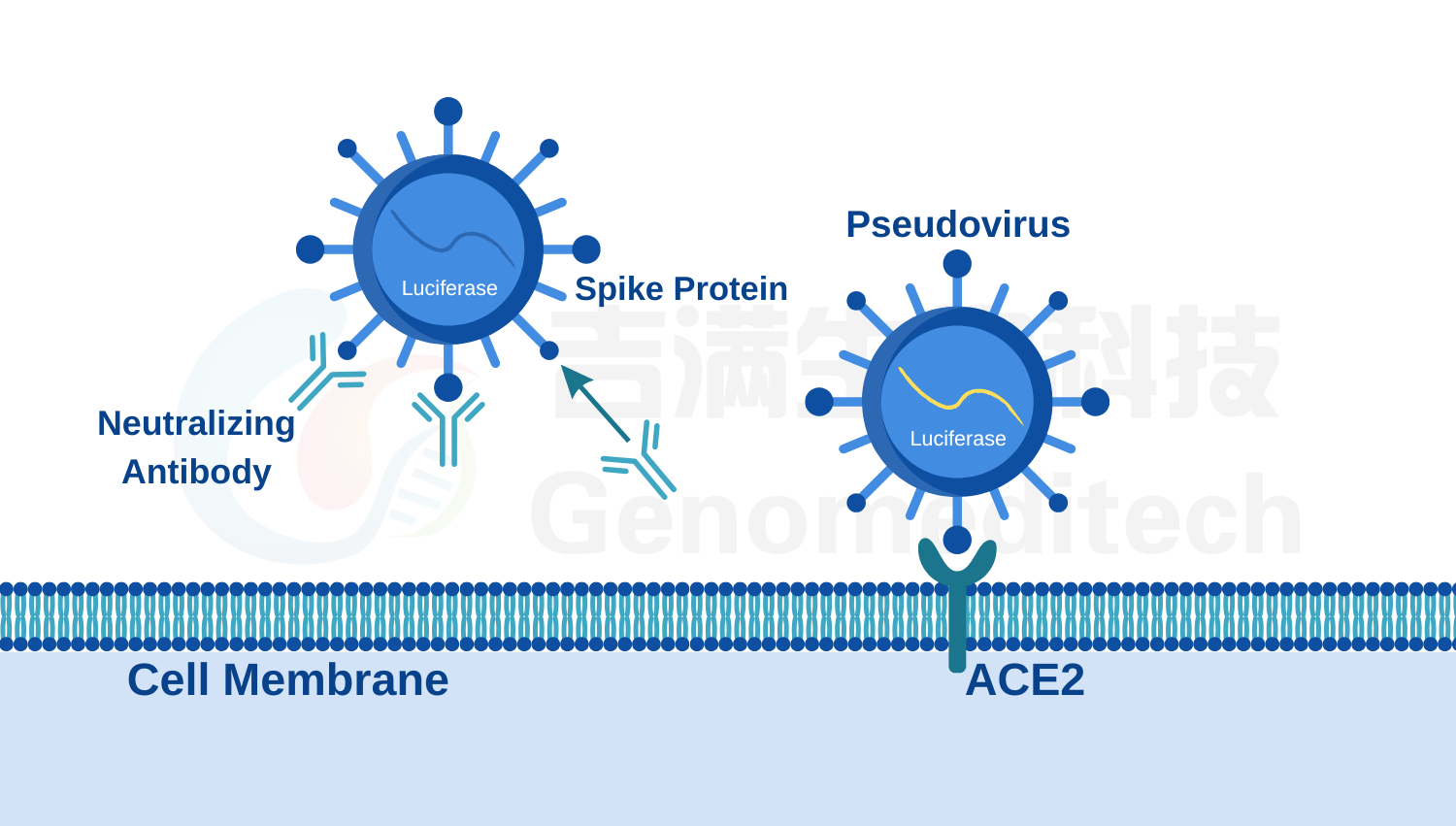
The Spike protein on the pseudovirus surface binds to the ACE2 receptor on host cells, mediating pseudoviral entry and accurately mimicking the natural virus process. Upon successful entry, the luciferase reporter gene expresses, and then generates a luminescent signal. Neutralizing antibodies can also block the binding between the Spike protein and ACE2, thereby preventing the pseudovirus from infecting host cells. By measuring the expression level of luciferase, the viral inhibition can be quantified.





| Product No. | Product Name | Gene | Pre-order/order |
Scenario 1: Neutralizing Antibody Assay & Vaccine Efficacy Evaluation (Core Application)
During the development of vaccines or antibody drugs against viruses like SARS-CoV-2 and MERS, there is an urgent need to evaluate their ability to block viral entry. However, handling natural viruses carries high biological risks and suffers from low throughput.
Genomeditech Solutions:
Utilize our pseudoviruses paired with the corresponding receptor-overexpressing cell lines (e.g., H_ACE2 HEK-293T, H_DPP4 HEK-293T).
Workflow: Pre-incubate candidate antibodies/antisera with the pseudovirus→Add the mixture to receptor-expressing cells →Detect the reporter gene signal. The degree of signal reduction directly reflects the neutralizing potency.
Application Value:
a. Rapidly evaluate neutralizing antibody titers in post-vaccination antisera.
b. Perform high-throughput screening and identification of neutralizing monoclonal antibodies (mAbs).
c. Investigate the immune evasion characteristics of viral variants (e.g., Omicron).
Scenario 2: Viral Entry Mechanisms & Receptor Research
The specific receptors for emerging viruses (New World alphaviruses, Dehong virus, etc.) remain unknown, or the viruses exhibit multiple potential receptors .
Genomeditech Solutions:
Leverage cell lines expressing various candidate receptors (the MXRA8-expressing cell line, which serves as the specific receptor for Chikungunya) or cells with specific gene knockdowns/knockouts.
Application Value:
a. Identifying Key Receptors: Identify and confirm key receptors for viral entry by observing differences in pseudovirus infection across different cell lines.
b. Analyzing Viral Tissue Tropism: Investigate the infection efficiency of viruses in cell lines derived from various tissue origins.
Scenario 3: Antiviral Drug Screening & Evaluation
Efficiently screen and identify the top choices capable of blocking viral entry from libraries containing thousands of compounds.
Genomeditech Solutions:
Establish a high-throughput screening (HTS) model based on the pseudovirus-receptor cell platform.
Application Value:
a. Accelerated Discovery: Evaluate the blocking efficacy of small-molecule inhibitors and peptide drugs targeting the viral entry step.
b. Specificity Validation: Confirm whether mechanism of action of drugs is directly related to viral envelope proteins or host cell receptors.

Pseudovirus utilize an HIV-1 lentivirus backbone to precisely mimic the entry mechanism of natural viruses, serving as a safe and highly efficient tool for foundational biopharmaceutical research. The product line covers a wide range of critical targets (SARS-CoV-2, MERS, Chikungunya, etc.), encompassing both receptor-expressing cell lines and pseudovirus particles to fully accelerate antiviral research.
Core Advantages
1. High Safety: Non-pathogenic and operable in BSL-2 laboratories.
2. Precise Quantification: Carrying reporter genes to enable precise quantification of infection results.
3. High Fidelity: The surface structure is highly consistent with natural viruses, authentically mimicking the entire entry process.
4. Stable Supply: The mature lentivirus packaging platform guarantees high batch-to-batch consistency of pseudovirus, enabling sustainable and long-term production.
Pseudovirus-Based Neutralization Assays
The Spike protein on the pseudovirus surface binds to the ACE2 receptor on host cells, mediating pseudoviral entry and accurately mimicking the natural virus process. Upon successful entry, the luciferase reporter gene expresses, and then generates a luminescent signal. Neutralizing antibodies can also block the binding between the Spike protein and ACE2, thereby preventing the pseudovirus from infecting host cells. By measuring the expression level of luciferase, the viral inhibition can be quantified.
| Product No. | Product Name | Gene | Pre-order/order |
Scenario 1: Neutralizing Antibody Assay & Vaccine Efficacy Evaluation (Core Application)
During the development of vaccines or antibody drugs against viruses like SARS-CoV-2 and MERS, there is an urgent need to evaluate their ability to block viral entry. However, handling natural viruses carries high biological risks and suffers from low throughput.
Genomeditech Solutions:
Utilize our pseudoviruses paired with the corresponding receptor-overexpressing cell lines (e.g., H_ACE2 HEK-293T, H_DPP4 HEK-293T).
Workflow: Pre-incubate candidate antibodies/antisera with the pseudovirus→Add the mixture to receptor-expressing cells →Detect the reporter gene signal. The degree of signal reduction directly reflects the neutralizing potency.
Application Value:
a. Rapidly evaluate neutralizing antibody titers in post-vaccination antisera.
b. Perform high-throughput screening and identification of neutralizing monoclonal antibodies (mAbs).
c. Investigate the immune evasion characteristics of viral variants (e.g., Omicron).
Scenario 2: Viral Entry Mechanisms & Receptor Research
The specific receptors for emerging viruses (New World alphaviruses, Dehong virus, etc.) remain unknown, or the viruses exhibit multiple potential receptors .
Genomeditech Solutions:
Leverage cell lines expressing various candidate receptors (the MXRA8-expressing cell line, which serves as the specific receptor for Chikungunya) or cells with specific gene knockdowns/knockouts.
Application Value:
a. Identifying Key Receptors: Identify and confirm key receptors for viral entry by observing differences in pseudovirus infection across different cell lines.
b. Analyzing Viral Tissue Tropism: Investigate the infection efficiency of viruses in cell lines derived from various tissue origins.
Scenario 3: Antiviral Drug Screening & Evaluation
Efficiently screen and identify the top choices capable of blocking viral entry from libraries containing thousands of compounds.
Genomeditech Solutions:
Establish a high-throughput screening (HTS) model based on the pseudovirus-receptor cell platform.
Application Value:
a. Accelerated Discovery: Evaluate the blocking efficacy of small-molecule inhibitors and peptide drugs targeting the viral entry step.
b. Specificity Validation: Confirm whether mechanism of action of drugs is directly related to viral envelope proteins or host cell receptors.