





Current position:News > News > Insights
GLP-1:Amgen’s MariTide Demonstrates 20% Weight Loss
吉满生物
2024-11-28

Nov. 26, 2024, Amgen today announced positive data at 52 weeks in a double-blind, dose-ranging Phase 2 study with MariTide (maridebart cafraglutide, formerly AMG 133), an investigational antibody peptide conjugate subcutaneously administered monthly or less frequently. In people living with obesity or overweight without Type 2 diabetes, MariTide demonstrated up to ~20% average weight loss at week 52 without a weight loss plateau, indicating the potential for further weight loss beyond 52 weeks. The study also showed people living with obesity or overweight and Type 2 diabetes, who typically lose less weight on GLP-1 therapies, achieved up to ~17% average weight loss, also without a weight loss plateau, and lowered their average hemoglobin A1C (HbA1c) by up to 2.2 percentage points at week 52.In summary, in both study populations, a weight loss plateau was not observed, again indicating the potential for further weight loss beyond 52 weeks. Learn more about our GLP catalog.
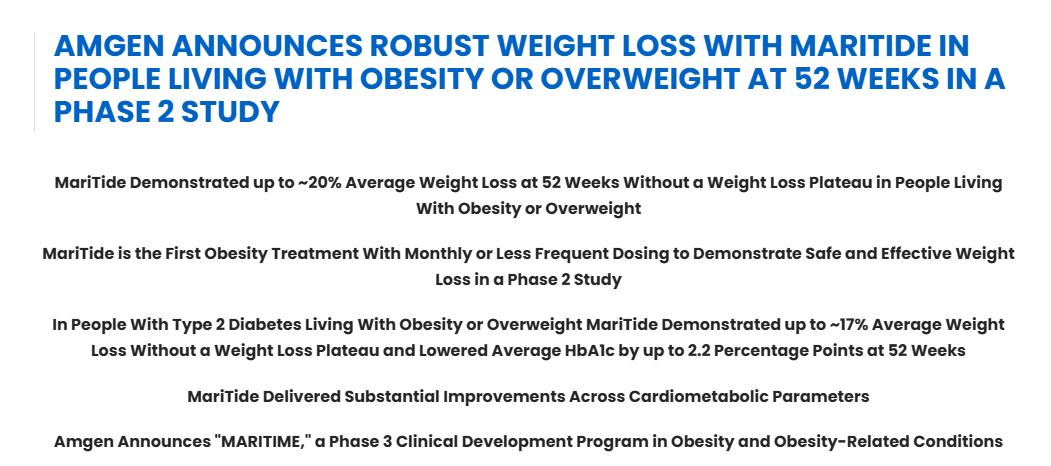
image.png

MariTide also demonstrated robust and clinically meaningful improvements in cardiometabolic parameters, including blood pressure, triglycerides and high-sensitivity C-reactive protein (hs-CRP) across doses. There were no significant increases in free fatty acids.

There was no association between the administration of MariTide and bone mineral density changes.

The most common adverse events (AEs) in the Phase 2 study were gastrointestinal (GI) related, including nausea, vomiting and constipation. Nausea and vomiting were predominately mild, transient and primarily associated with the first dose. The incidence of nausea and vomiting was substantially reduced with dose escalation. In the dose escalation arms, for those with symptoms, nausea and vomiting were episodic; generally resolving within a median window of six days for nausea and one to two days for vomiting. The discontinuation rate in the dose escalation arms due to any AE was ~11% and less than 8% for GI-related events. No additional safety signals were identified. In a separate ongoing Phase 1 pharmacokinetic study, additional dosing regimens have been evaluated in a planned preliminary analysis.

"We are very excited by MariTide's differentiated profile, with clinically meaningful attributes of substantial and progressive weight loss, monthly or less frequent dosing, significant improvements in cardiometabolic parameters and strong reduction of HbA1C," said Jay Bradner, M.D., executive vice president of Research and Development and chief scientific officer at Amgen. "These results provide us confidence to initiate MARITIME, a Phase 3 program across obesity and a number of related conditions, providing a unique potential new treatment option for patients."

Data from this Phase 2 study will be presented at a future medical congress and submitted for publication.

The ongoing Part 2 of the Phase 2 study is investigating MariTide beyond 52 weeks to evaluate further weight loss with continued treatment, weight maintenance through less frequent or lower dosing and durability of weight loss after discontinuation of MariTide. More than 90% of eligible patients chose to continue to participate in Part 2 of the study.

MariTide is expected to be delivered as a single dose in a convenient, handheld, patient-friendly, autoinjector device with a monthly or less frequent single-injection administration. MariTide is produced in Amgen's industry-leading manufacturing network.

Amgen is also advancing its obesity pipeline, which includes both oral and injectable approaches, composed of both incretin and non-incretin mechanisms.



Latest news
Insights
2025-12-12
ADCC, ADCP, and CDC: Antibody Structure and Class Considerations
Antibodies have evolved into versatile therapeutic platforms, capable of not only targeting disease cells but also activating the immune system through ADCC, ADCP, and CDC. Advances in Fc engineering—such as glycoengineering, targeted mutations, and FcRn optimization—are now enhancing antibody potency, selectivity, and half-life, unlocking new opportunities in oncology, autoimmune disorders, and infectious diseases.
Insights
2025-12-04
BCMA Drives Accelerated Expansion into the Autoimmune Therapeutics Field
BCMA, a well-established target in blood cancers, is now expanding its impact into autoimmune diseases. Leveraging its highly specific expression and favorable safety profile, BCMA is at the forefront of innovative therapies, including CAR-T cells, bispecific and trispecific antibodies, and antibody-drug conjugates.

Recent collaborations and rapid clinical advancements highlight BCMA as a key focus for next-generation immune-targeted treatments. Learn how this promising target is reshaping the future of immunotherapy and opening new possibilities for patients worldwide.
Insights
2025-11-27
Toll-Like Receptors: Key Components of Innate Immunity
Toll-Like Receptors (TLRs) are emerging as one of the most promising frontiers in immunotherapy.

With major licensing deals and expanding clinical applications, TLR-targeting drugs are gaining rapid momentum. Their central role in innate immunity—driving antiviral, inflammatory, and vaccine responses—makes them powerful targets for next-generation therapies.

From cancer to infectious diseases, the commercial and scientific potential is growing fast.
Current position:News > News > Insights
classify
GLP-1:Amgen’s MariTide Demonstrates 20% Weight Loss
吉满生物
2024-11-28

Nov. 26, 2024, Amgen today announced positive data at 52 weeks in a double-blind, dose-ranging Phase 2 study with MariTide (maridebart cafraglutide, formerly AMG 133), an investigational antibody peptide conjugate subcutaneously administered monthly or less frequently. In people living with obesity or overweight without Type 2 diabetes, MariTide demonstrated up to ~20% average weight loss at week 52 without a weight loss plateau, indicating the potential for further weight loss beyond 52 weeks. The study also showed people living with obesity or overweight and Type 2 diabetes, who typically lose less weight on GLP-1 therapies, achieved up to ~17% average weight loss, also without a weight loss plateau, and lowered their average hemoglobin A1C (HbA1c) by up to 2.2 percentage points at week 52.In summary, in both study populations, a weight loss plateau was not observed, again indicating the potential for further weight loss beyond 52 weeks. Learn more about our GLP catalog.

image.png

MariTide also demonstrated robust and clinically meaningful improvements in cardiometabolic parameters, including blood pressure, triglycerides and high-sensitivity C-reactive protein (hs-CRP) across doses. There were no significant increases in free fatty acids.

There was no association between the administration of MariTide and bone mineral density changes.

The most common adverse events (AEs) in the Phase 2 study were gastrointestinal (GI) related, including nausea, vomiting and constipation. Nausea and vomiting were predominately mild, transient and primarily associated with the first dose. The incidence of nausea and vomiting was substantially reduced with dose escalation. In the dose escalation arms, for those with symptoms, nausea and vomiting were episodic; generally resolving within a median window of six days for nausea and one to two days for vomiting. The discontinuation rate in the dose escalation arms due to any AE was ~11% and less than 8% for GI-related events. No additional safety signals were identified. In a separate ongoing Phase 1 pharmacokinetic study, additional dosing regimens have been evaluated in a planned preliminary analysis.

"We are very excited by MariTide's differentiated profile, with clinically meaningful attributes of substantial and progressive weight loss, monthly or less frequent dosing, significant improvements in cardiometabolic parameters and strong reduction of HbA1C," said Jay Bradner, M.D., executive vice president of Research and Development and chief scientific officer at Amgen. "These results provide us confidence to initiate MARITIME, a Phase 3 program across obesity and a number of related conditions, providing a unique potential new treatment option for patients."

Data from this Phase 2 study will be presented at a future medical congress and submitted for publication.

The ongoing Part 2 of the Phase 2 study is investigating MariTide beyond 52 weeks to evaluate further weight loss with continued treatment, weight maintenance through less frequent or lower dosing and durability of weight loss after discontinuation of MariTide. More than 90% of eligible patients chose to continue to participate in Part 2 of the study.

MariTide is expected to be delivered as a single dose in a convenient, handheld, patient-friendly, autoinjector device with a monthly or less frequent single-injection administration. MariTide is produced in Amgen's industry-leading manufacturing network.

Amgen is also advancing its obesity pipeline, which includes both oral and injectable approaches, composed of both incretin and non-incretin mechanisms.


Message consultation
reset
submit
Message
Message consultation
reset
submit