










Innovent Biologics has reported a positive Phase 3 result for its CLDN18.2-targeted ADC, IBI343 (arcotatug tavatecan/TAK-921), in patients with previously treated, advanced gastric or gastroesophageal junction adenocarcinoma across China and Japan. The study met its primary endpoint of progression-free survival versus investigator’s choice chemotherapy, though detailed efficacy and safety data have not yet been disclosed.
The result strengthens Innovent’s position in the highly competitive CLDN18.2 field, where multiple companies are advancing antibodies, ADCs, and bispecifics targeting the same antigen. The program is partnered with Takeda for ex-China rights, reflecting strong global interest in the asset class.
CLDN18.2 has become a key oncology target following approval of an antibody from Astellas Pharma, with additional programs also in development at companies such as AstraZeneca.
About CLDN18.2
Claudin 18.2 (CLDN18.2) is normally restricted to gastric mucosal tissue in healthy organisms, but is aberrantly and highly expressed on the cell membranes of tumor cells in gastric cancer, pancreatic cancer, cholangiocarcinoma, and other malignancies.
The claudin protein family comprises at least 27 transmembrane proteins that are widely expressed across multiple tissues and serve as key components of tight junctions. CLDN18 consists of two extracellular loops, four transmembrane domains, and a cytoplasmic domain, with both its N-terminus and C-terminus located intracellularly.
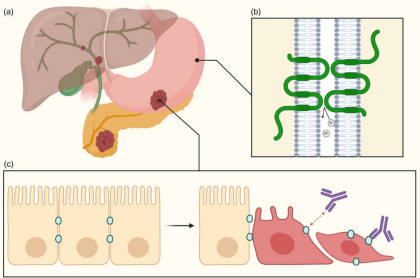
 The CLDN18 gene produces two splice variants, CLDN18.1 and CLDN18.2, which are predominantly expressed in lung and gastric tissues, respectively. CLDN18.1 is mainly expressed in type I alveolar epithelial cells and plays a critical role in maintaining alveolar epithelial barrier integrity and structural organization. Studies in CLDN18.1 knockout mice have demonstrated that loss of Cldn18.1 results in increased lung size, progenitor cell proliferation, and tumourgenesis in mice.
CLDN18.2 is primarily expressed in normal gastric tissue, while its expression is downregulated in gastric cancer tissue. However, it is highly activated in a range of other malignancies, including pancreatic, esophageal, biliary tract, ovarian, and lung cancers. Notably, CLDN18.2 remains highly expressed during gastric tumorigenesis and continues to be detected in metastatic lesions. Therefore, CLDN18.2 is considered an ideal therapeutic target, particularly for gastrointestinal tumors.
CLDN18.2 Targeted Therapy
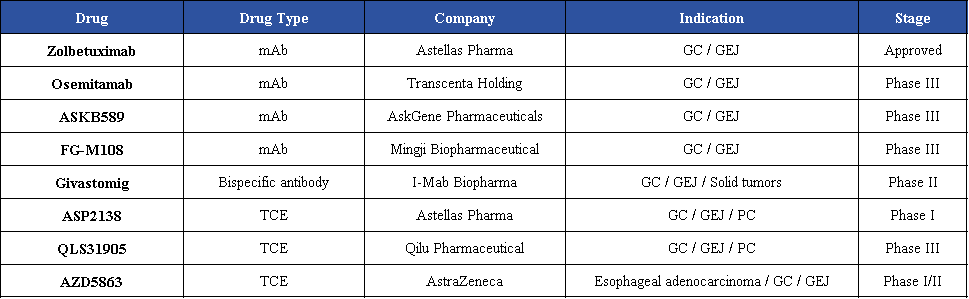
Currently, the only CLDN18.2-targeted drug that has been approved globally is Astellas’ zolbetuximab. Meanwhile, CAR-T product satricabtagene autoleucel developed by CARsgen Therapeutics is currently under regulatory review.
In addition, multiple therapeutic modalities targeting CLDN18.2 are under active development, including monoclonal antibodies (mAbs), bispecific antibodies (BsAbs), antibody–drug conjugates (ADCs), and CAR-T cell therapies.
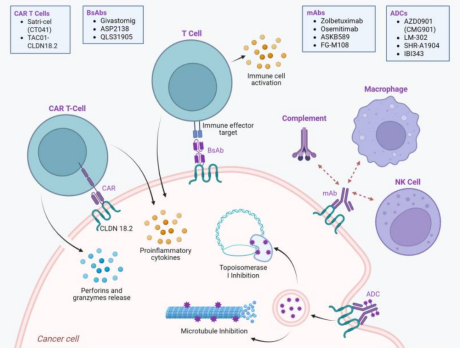
Zolbetuximab is a humanized monoclonal antibody targeting CLDN18.2 and represents the first approved therapy for CLDN18.2-positive gastrointestinal tumors. It recognizes a specific epitope within the first extracellular loop of CLDN18.2, enabling highly selective tumor targeting through strong binding affinity.
In CLDN18.2-positive gastric cancer and gastroesophageal junction cancer (GC/GEJC) cell lines, the antitumor activity of zolbetuximab is primarily mediated through antibody-dependent cellular cytotoxicity (ADCC) and complement-dependent cytotoxicity (CDC). In combination with chemotherapy, it has been approved by the FDA as a first-line treatment for patients with unresectable, locally advanced, or metastatic HER2-negative, CLDN18.2-positive GC/GEJC.
As the world’s first and only approved CLDN18.2-targeting monoclonal antibody, VYLOY generated revenue of ¥63.1 billion (about $400 million USD) in 2025, representing a remarkable year-over-year growth of 415.6%, making it one of the most striking figures in the annual report.
Bispecific antibodies, by simultaneously binding CLDN18.2 and co-stimulatory molecules such as CD3 or 4-1BB, activate T cells and other immune effector cells. In recent years, CLDN18.2-targeting bispecific antibodies have become an important research direction, demonstrating promising clinical potential in gastric cancer, gastroesophageal junction cancer, and pancreatic cancer.
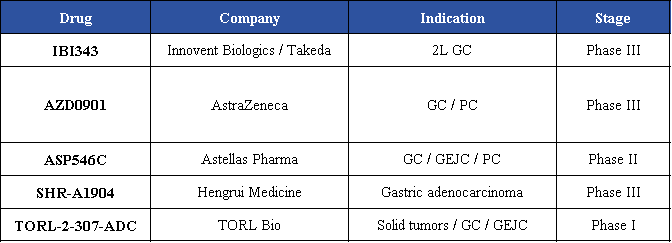
Compared with monoclonal antibodies, ADCs (antibody–drug conjugates) can be internalized after binding to CLDN18.2 on tumor cells and subsequently release potent cytotoxic payloads intracellularly, thereby demonstrating stronger antitumor activity.
In the CLDN18.2 ADC space, three candidates have entered Phase III clinical trials, reflecting emerging late-stage competition.
Among them, IBI343 from Innovent Biologics is currently the most advanced candidate and has submitted an NDA to China’s NMPA. However, its clinical development is primarily focused on China and Japan. On the global stage, IBI343 remains in Phase II, while AstraZeneca’s AZD0901 is considered one of the leading CLDN18.2 ADC programs worldwide.
CAR-T cells are genetically engineered to recognize CLDN18.2 and directly induce tumor cell lysis by releasing perforin, granzymes, and cytokines.

Conclusion
Overall, CLDN18.2-targeted therapy is transitioning from a single approved drug to a multi-technology competitive landscape. Against the backdrop of rapid sector development, demand across the entire value chain—from basic research to drug development—continues to grow, highlighting the increasing importance of research tools such as cell lines and antibodies.
In this context, Genomeditech provides CLDN18.2-related cell lines and antibodies, supported by a high-standard quality control system, enabling cutting-edge research and supporting drug development and regulatory submissions.
Reference List
Singh P, Toom S, Huang Y. Anti-Claudin 18.2 antibody as new targeted therapy for advanced gastric cancer. J Hematol Oncol. 2017;10:105. doi:10.1186/s13045-017-0473-4.
Dominguez Wiscovitch A, Sanchez Mendez RJ, Chuy J. CLDN18.2-targeted therapy in gastrointestinal cancers. Cancers (Basel). 2025;17(23):3764. doi:10.3390/cancers17233764.
Chen J, Xu Z, Hu C, Zhang S, Zi M, Yuan L, et al. Targeting CLDN18.2 in cancers of the gastrointestinal tract: new drugs and new indications. Front Oncol. 2023;13:1132319. doi:10.3389/fonc.2023.1132319.
S. Food and Drug Administration. FDA approves zolbetuximab (CLDN18.2) in combination with chemotherapy for gastric or gastroesophageal junction adenocarcinoma [Internet]. Available from: https://www.fda.gov/drugs/resources-information-approved-drugs/fda-approves-zolbetuximab-clzb-chemotherapy-gastric-or-gastroesophageal-junction-adenocarcinoma
ClinicalTrials.gov. A Phase 3, Randomized, Double-blind, Placebo-controlled Study Evaluating Combination of TST001, Pembrolizumab and Chemotherapy as First-Line Treatment in Subjects With Claudin 18.2 Positive Locally Advanced or Metastatic Gastric or Gastroesophageal Junction Adenocarcinoma (NCT06093425) [Internet]. Available from: https://clinicaltrials.gov/study/NCT06093425
ClinicalTrials.gov. A Study of ASKB589 in Combination With Chemotherapy in Subjects With Advanced Gastric or Gastroesophageal Junction Cancer (NCT06206733) [Internet]. Available from: https://clinicaltrials.gov/study/NCT06206733
ClinicalTrials.gov. A Study of FG-M108 in Subjects With Advanced Solid Tumors (NCT07383922) [Internet]. Available from: https://clinicaltrials.gov/study/NCT07383922
ClinicalTrials.gov. A Randomized, Multicenter, Open-Label, Phase 2 Study of Givastomig (TJ033721) in Combination With Nivolumab and Chemotherapy Versus Nivolumab and Chemotherapy in Participants With Previously Untreated CLDN18.2 Positive and PD-1L Positive Locally Advanced or Metastatic Gastric, Esophageal, or Gastroesophageal Junction Adenocarcinoma (NCT07432295) [Internet]. Available from: https://clinicaltrials.gov/study/NCT07432295
ClinicalTrials.gov. A Study of ASP2138 in Participants With Advanced Solid Tumors (NCT05365581) [Internet]. Available from: https://clinicaltrials.gov/study/NCT05365581
ClinicalTrials.gov. A Study of QLS31905 in Participants With Advanced Gastric or Gastroesophageal Junction Cancer (NCT07079228) [Internet]. Available from: https://clinicaltrials.gov/study/NCT07079228
ClinicalTrials.gov. A Study of AZD5863, a T Cell-engaging Bispecific Antibody That Targets Claudin 18.2 (CLDN18.2) and CD3, in Adult Participants With Advanced or Metastatic Solid Tumors (NCT06005493) [Internet]. Available from: https://clinicaltrials.gov/study/NCT06005493
ClinicalTrials.gov. A Study of IBI343 in Participants With Advanced or Metastatic Solid Tumors (NCT07066098) [Internet]. Available from: https://clinicaltrials.gov/study/NCT07066098
ClinicalTrials.gov. A Phase III, Multicentre, Randomised Controlled Study of Sonesitatug Vedotin in Combination With Capecitabine With or Without Rilvegostomig in First-Line Claudin18.2-Positive, HER2-Negative, Advanced/Metastatic Gastric, Gastroesophageal Junction, or Esophageal Adenocarcinoma (CLARITY-Gastric 02) (NCT07431281) [Internet]. Available from: https://clinicaltrials.gov/study/NCT07431281
ClinicalTrials.gov. A Phase 1b/2 Open-label Study to Assess the Safety and Efficacy of ASP546C in Participants With CLDN18.2-Expressing Locally Advanced Unresectable or Metastatic Gastroesophageal Adenocarcinoma, Pancreatic Adenocarcinoma or Other Solid Tumor Types (NCT07488676) [Internet]. Available from: https://clinicaltrials.gov/study/NCT07488676
ClinicalTrials.gov. A Study of SHR-A1904 in Participants With Advanced Solid Tumors (NCT06649292) [Internet]. Available from: https://clinicaltrials.gov/study/NCT06649292
ClinicalTrials.gov. A Phase 1/2 Dose Escalation, Pharmacokinetic, Safety, and Efficacy Study of Oral TAC-101 in Patients With Advanced Hepatocellular Carcinoma (NCT00077142) [Internet]. Available from: https://clinicaltrials.gov/study/NCT00077142
ClinicalTrials.gov. A Study of CT041 in Participants With Claudin 18.2 Positive Gastric, Pancreatic, and Other Solid Tumors (NCT05911217) [Internet]. Available from: https://clinicaltrials.gov/study/NCT05911217